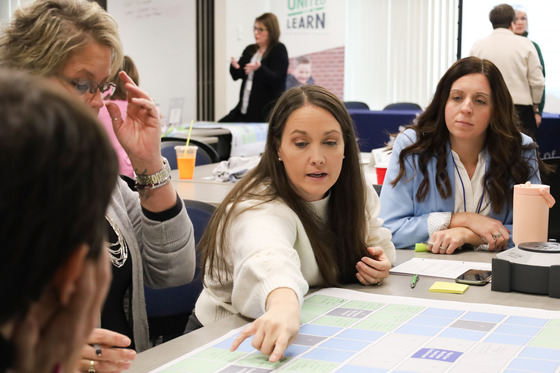
Kentucky Department of Education Regional Innovation Specialist Jennifer Young, center, participates in a brainstorming exercise at the Kentucky United We Learn Council’s Jan. 23 meeting. Photo by Myles Young, Kentucky Department of Education, Jan. 23, 2026.
|
|
Kentucky United We Learn Council discusses high school transformation, council’s next steps during convening
(FRANKFORT, KY) – The Kentucky United We Learn Council met to discuss progress made with assessment and accountability reform and efforts to reimagine the high school experience in Kentucky during its meeting on Jan. 23.
The Kentucky United We Learn Council is a dedicated group of educators, students, family members, community members, policymakers and staff with the Kentucky Department of Education (KDE) who bring together voices from across the Commonwealth to reimagine what’s possible for Kentucky’s students.
The council and KDE have worked closely together to co-create a new Model Framework that details recommendations for a new vision of the state’s assessment and accountability systems, focusing on more local input and encouraging vibrant learning experiences for every student.
The council’s meeting started with a discussion on where assessment and accountability efforts stand, including a breakdown of what has been included in House Bill (HB) 257, a piece of legislation filed by Rep. J.T. Payne that was influenced by the work of the Kentucky United We Learn Council.
Commissioner of Education Robbie Fletcher and KDE Associate Commissioner Jennifer Stafford explained elements of the bill and how it differs from the Model Framework 4.0. Many facets of the bill are explained in the HB 257 rundown on Kentucky Teacher.
Fletcher said he and the KDE team met with members of the education committees in the House and Senate, along with legislative leadership in both chambers, over the past several months to discuss potential legislation. He said the local accountability portion in HB 257 is “the absolute best part of this proposal” and critical to making a difference in the classroom.
“For those of you that have a local accountability model across the state, I hear stories like it has restored faith in our school community; it has restored faith in our public education system,” Fletcher said. “I hear stories about how we get more input from our community. I hear stories about how … any problems that we have at the school, it becomes a community problem where we try to solve it together.”
Council members discussed elements of HB 257, including how the climate and safety survey would be dropped in favor of including chronic absenteeism in the state accountability model. They also provided feedback on how student growth is measured under the proposal and the current system.
Alexa Hardin, regional innovative specialist for northeast Kentucky in KDE’s Division of Innovation, provided council members with an overview of KDE’s Local Accountability Design Guide and Toolkit. The guide provides a step-by-step approach, real examples from across the Commonwealth and practical tools to help schools and communities design accountability systems that reflect local priorities and create vibrant learning experiences for every student.
The council’s discussion then shifted to efforts to transform the high school education experience.
Kentucky Board of Education Vice Chair Lu S. Young told council members about how their efforts with assessment and accountability have worked alongside KDE’s efforts to transform high schools, which started years ago with pilot programs focused on fostering innovation and through greater local flexibility. This has included community-driven portraits of a learner, which are sets of high-level competencies and priorities that guide districts in the design of local accountability systems and outline the essential skills, knowledge, and dispositions every student needs to thrive in an ever-changing world.
“This work is also a promise to the young people in the room and to Kentucky students across the Commonwealth, because our students are telling us this is the kind of learning they want,” Young said. “They want learning that matters. … They want pathways that open real doors.”
|
|
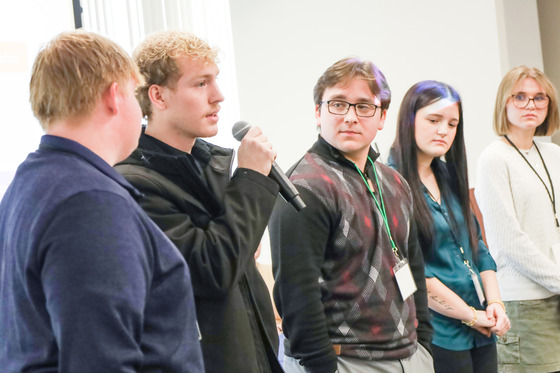
Students, from left, Jace Harper, Allen County schools; Jonah Hamby, Allen County schools; Terry Davidson, Hazard Independent High School; Ali Caldwell, Hazard Independent High School; and Grace Wilson of the Kentucky Student Voice Team and STEAM Academy, discussed their high school experiences with members of the Kentucky United We Learn Council during their meeting on Jan. 23. Photo by Myles Young, Kentucky Department of Education, Jan. 23, 2026.
|
|
The National Association of State Boards of Education (NASBE) also invited the Kentucky Board of Education to participate in its High School Transformation State Network, which builds the capacity of state boards to enable rich student experiences that foster content mastery and durable skills.
The Kentucky High School Transformation Work Group is made up of individuals focused on examining policies and implementation practices that affect the high school experience.
“This initiative advances the core commitments of United We Learn,” Young said. “It strengthens the work happening across our local laboratories of learning, it aligns to our state portrait of a learner, and it amplifies Kentucky’s leadership on the national stage by sharing the insights, innovations and learning strategies we’ve built together.
Several groups came in to discuss the high school experience and ways it can be reformed, including a roundtable discussion about efforts at the local level with leaders from the Ignite Institute (Boone County), STEAM Academy (Fayette County), Madisonville North Hopkins High School (Hopkins County), the Hardin County Schools Early College and Career Center, iLead Academy and the WeLead Computer Science Kentucky Virtual Career Academy.
Representatives with the Kentucky Student Voice Team along with students from Allen County, Hazard Independent and the STEAM Academy (Fayette County) also made a presentation, highlighting the importance of student voice in transformation efforts.
The council later broke off into groups to brainstorm ideas around the high school experience, including best practices, policy considerations and barriers to transformation. Some of the discussions in the groups focused on current local efforts to transform the high school experience, including how to involve the community and student recommendations in those efforts, and discussion about funding challenges.
The council also welcomed 15 new members this year, including nine students.