|
FRANKFORT, Ky. (Sept. 17, 2025) — Lawmakers on the Interim Joint Committee on Health Services received an update Tuesday from the director of the University of Kentucky Cannabis Center.
In 2022, House Bill 604 established the cannabis center with a $2 million appropriation for a multitude of projects.
Shanna Babalonis, director of the center in Lexington, testified about some of the projects that staff members have been undertaking. She also offered information about future plans.
Babalonis said the center is conducting, or hoping to conduct, three projects funded through the National Institutes of Health.
One of them – for $2.8 million – determines how cannabis may alter opioid withdrawal, reward and safety.
“We enrolled patients into the UK hospital and give them cannabis under controlled conditions and look at how cannabis alters that opioid withdrawal profile,” she said.
Babalonis said an important goal of the project is to examine safety to learn if cannabis alters opioid-induced respiratory depression.
A second $2.87 million NIH grant would look at how cannabis may alter the drive to take opioids in people with opioid use disorder. Babalonis said a decision on this funding is expected soon.
Babalonis said the center also recruited a new faculty member who brought along a grant with her.
The third NIH grant for $720,000 determines how repeated cannabidiol (CBD) doses modify tetrahydrocannabinol (THC) abuse potential and pain relief, she said.
The center has two additional grants now under review. One would determine how cannabis with THC and CBD interaction effects change abuse potential and find out if the addition of CBD helps decrease the abuse potential of concentrates or dabs.
The second grant would look at the effects of a minor cannabinoid compound – one that does not get people high – on pain outcomes, anti-nausea and abuse potential, Babalonis said.
Babalonis also discussed a clinical trial on patients with active cancer and several completed projects, which include a trial on the interaction of inhaled cannabis and intranasal opioids, a trial on the impact of cannabis on simulated driving performance, and analytical chemistry projects to test products for cannabinoid content and contamination.
Sen. Karen Berg, D-Louisville, asked Babalonis about overdoses in children.
“Is there any effort going on nationwide to package this less attractively for children, and is there a way to address that,” she asked.
Babalonis indicated that nothing substantial is occurring nationwide.
“We’re actually putting things out there that look like candy and taste like candy. And for a kid to get their hand in a candy jar. You know, it seems nonsensical to me if we’re going to use this as medicinal, to make it look like candy,” Berg said.
Rep. Rebecca Raymer, R-Morgantown, said there is a difference between natural cannabis and synthetic cannabis. She expressed concern about children who become ill after ingesting substances such as Delta-8.
“I don’t think everybody understands the difference, and I would be interested in getting some more information on the symptoms they were seeing when these kids came in, if it was just the central nervous system, depression, or if there were other things,” she said. “We know there’s dangers with the solvents that they’re using to extract these higher levels of THC.”
Sen. Donald Douglas, R-Nicholasville, said those at the center have a tough job.
“Your job is to be objective in spite of all the anecdotal beliefs that people have,” he said.
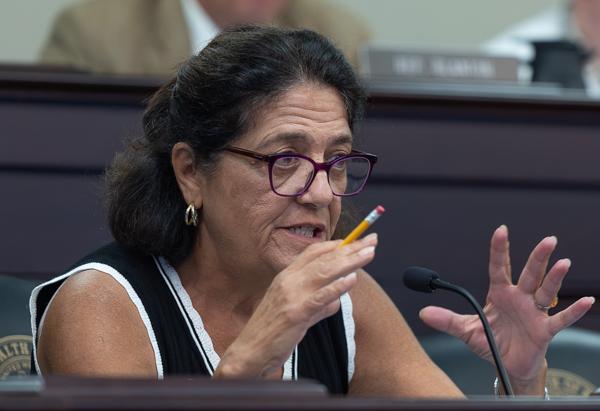
Rep. Lisa Willner, D-Louisville, asked Babalonis about the study of cannabis and PTSD. Willner said the center’s employees have been able to accomplish many things in a short amount of time.
“I know that there’s not been a lot of study about cannabis and PTSD. But, the National Institutes of Health, the Veterans Administration have both declared it contraindicated for that condition,” Willner said.
Babalonis said patients who are “fragile” should not be administered high doses of THC, and data collected to date are inconclusive and placebo-like. However, she said staff at the center could examine this issue if the legislature requests it.
|