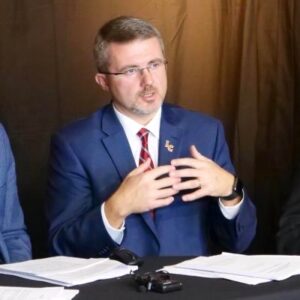

Members of the Kentucky Department of Education’s (KDE’s) Commissioner’s Student Advisory Council started discussing a proposed project on postsecondary readiness and the role of the Individual Learning Plan (ILP) during their meeting on Dec. 9.
KDE has an interagency work group currently reviewing and making updates to ILP resources. The Commissioner’s Student Advisory Council is engaging in a review of ILP resources to provide feedback on how to use ILP resources to best impact postsecondary readiness.
As defined in 704 KAR 19:002, the ILP is a “comprehensive framework for advising students in grades 6 through 12 to engage in coursework and activities that will best prepare them to both realize college and career success and become contributing members of their communities.”
Throughout the next few months, Commissioner’s Student Advisory Council members will be reviewing ILP and postsecondary planning resources and determining how they can be maximized to ensure a meaningful post-high school transition. They will select focus areas for in-depth exploration and provide student-centered recommendations to improve the clarity, usability and impact of ILP tools.
Students plan to present their findings and recommendations to the commissioner in April.
During the meeting, students broke into small groups to discuss their experiences with ILPs and how the ILP could be better utilized in middle school.
Delanie Crump, a sophomore at Boyd County High School, said her school has a college and career classroom. At the beginning of the year, they post all of the ILP requirements and students have assignments to work on their ILP.
However, Crump said there’s no requirement for students to work on their ILP every week; rather, some students might work on it after finishing other assignments. She said it would be helpful for students to have dedicated time to work on their ILP.
“It doesn’t have to be much, maybe like 20 minutes every couple of weeks just so people are constantly thinking about their future,” Crump said.
Several council members said they did not do much career planning in middle school. Crump said her school had a career interest quiz, but not much actual planning around possible careers. She believes it’s important for middle school students to think about possible career pathways, especially when they’re in 8th grade and picking out high school classes.
Daniel Ratley, a senior at Grayson County High School, said it’s a delicate balance because middle school students should still be able to explore many different options.
“We believe that for middle school students, they should have it much broader,” Ratley said. “They should keep all the doors open for their careers and just allow this kind of general exploration of all these different careers and just make sure you’re not thrown down one pathway too early or too soon, because you’re still very young and you can still be changing your mind a lot.”
Ratley also said many of his fellow students could benefit from putting more intentional focus on the ILP. He said one solution would be for schools to involve teachers and families more in the ILP.
“The students, the parents, as well as their teachers need to be aware of all the factors that they’ve put into the ILP,” Ratley said.
Prisha Shah, a sophomore at Ryle High School (Boone County), agreed that students could spend more time thinking about their postsecondary transition. She said one solution is for more schools to train teachers and other staff in basic career planning.
“We should encourage families to plan ahead, but the reality is that not a lot of them are going to, so we need a lot of school support and the vast majority of students are not going to go to the counselor or take the initiative to plan out their future,” Shah said. “I think we should give teachers a little bit of training on different career paths and how that plays out so they can tell their students about that.”
Graham Borden, a senior at Highlands High School (Fort Thomas Independent), said ILPs could focus more on other opportunities after high school than just college.
“We feel like within our schools, there’s definitely a larger emphasis on the progression from high school into postsecondary education through college, when in reality, trade school, apprenticeships or going directly into the workforce are also huge opportunities,” Borden said.
Commissioner of Education Robbie Fletcher said internship opportunities can be a good way for schools to encourage students to plan their futures. He said schools could bring in local businesspeople to talk about different careers and introduce possible internships to students.
Members were asked if they would be willing to review resources in between this and their next meeting in February. They enthusiastically said yes. The Commissioner’s Student Advisory Council’s will meet in February to share their feedback on the resources reviewed.