











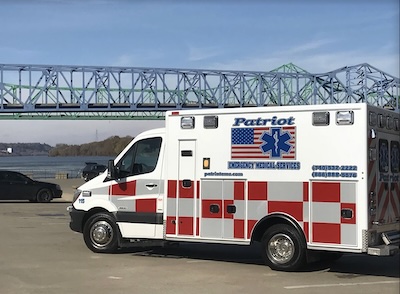
Patriot EMS Martin County and Lawrence are ‘in good shape’ but coverage in jeopardy because of lack of funding…
Ambulance coverage faces financial challenges
LOUISA, KY. — After news began to spread concerning the financial condition of Patriot EMS, the Ironton, Ohio based ambulance and paramedic company that serves Lawrence County.
Reports came in Wednesday when a Martin County newspaper and judge/Executive Lon Lafferty addressed the financial difficulties. Patriot Employees in Martin Co. said they did not get their paycheck last Friday.
But the owners of the service say the problem is state and federal reimbursements from Medicare and Medicaid as well as the current shutdown of the federal government.
“Both Martin County and Lawrence county ‘are good right now,” Krista Ellison, a spokesperson for Patriot said earlier today.
.
Louisa mayor Harold Slone issued the following statement:
“…On Monday, February 16th, I met directly with Patriot EMS officials to discuss their operations and their commitment to our community. During that meeting, the owners explained that they have been facing challenges related to slow reimbursement payments as well as extremely low reimbursement rates and are making operational adjustments in response.
They assured me they are committed to remaining in Louisa and stated they will continue providing three full-time ALS (Advanced Life Support) trucks staffed and operating 24 hours a day, 7 days a week for our community.
While I appreciate their assurances, I believe it is prudent for the City to explore other options in the meantime to ensure continuity of service should the situation worsen. The safety and well-being of our citizens will always be our top priority, and we must be proactive in planning for any potential changes.
We will continue maintaining open communication with Patriot EMS leadership and will keep the public informed of any developments.”
— Mayor Harold Slone

According to Kentucky Emergency Response Alliance data, nearly 92% of Kentucky’s counties are ambulance deserts, which means people live more than 25 minutes from the nearest ambulance service. (Kentucky Lantern photo by Sarah Ladd)
.
Kentucky’s ambulance deserts they are often overworked and underpaid
.
FRANKFORT — Emergency responders are warning that in Kentucky’s ambulance deserts they are often overworked and underpaid and use old equipment to treat patients who may live 90 minutes from the nearest hospital.
They gathered Tuesday in support of a bill that would result in higher reimbursements from insurers for their services. House Bill 447 would require insurance companies to reimburse ground ambulances at a rate set by the local government, or, if there is not a local rate set, 400% of the Medicare rate or an out-of-network provider’s billed charges.
“Patients are being put at risk when ambulance services are limited and when reimbursement falls short, someone has to cover the gap,” Rep. Rebecca Raymer, R-Morgantown, the sponsor of House Bill 447, said during a Tuesday press conference. “Too often, that burden falls on the local taxpayer.”
Her bill has nine cosponsors so far, all Republican.
Meanwhile, the Kentucky Association of Health Plans has expressed concern for consumers, saying based on the fiscal impact report that premiums for a family of four could increase by $60.96 a year.“Legislators should know that they are going to be pushing more people to the Medicaid rolls by making private insurance unaffordable for working families,” an association spokesperson said.

The ‘crisis’ facing Kentucky
According to Kentucky Emergency Response Alliance data, shared by Raymer to support her bill, nearly 92% of Kentucky’s counties are ambulance deserts, which means people live more than 25 minutes from the nearest ambulance service. The average response time for rural Kentucky emergencies is about 14 minutes.
According to that data, ambulance services in many counties are reimbursed for far less than the service cost:
-
Laurel County EMS gets less than 10% of services reimbursed.
-
Nelson County EMS gets less than 11% of services reimbursed.
-
Perry County EMS gets less than 24% of services reimbursed.
-
Muhlenberg County EMS is reimbursed for less than 28% of services.
-
Knox County EMS gets less than 33% of services reimbursed.
-
Boyle County EMS gets less than 37% of services reimbursed.
-
Lexington Fire EMS gets less than 39%.
-
Madisonville Medical Center EMS gets less than 43%.
-
Jessamine County EMS is reimbursed for less than 50% of services.
-
Adair County EMS providers are reimbursed for less than 60%.
The leftover gap, Raymer and others said, means counties have to either lose their ambulance service or raise local taxes to cover the cost, a situation Raymer called “unsustainable.”
“Inadequate reimbursement for ground ambulance services have pushed Kentucky’s EMS system into crisis,” she said. “In some counties, there is only one ambulance available to serve the entire community. Reimbursement rates have not kept pace with rising operational costs, forcing many ambulance providers to scale back services or shut down completely.”
‘The breaking point’

.
John Holder, the board chair of the Kentucky Board of Emergency Medical Services, said emergency service responders often have to work in multiple counties.
“This very morning, across the Commonwealth of Kentucky, there were untold numbers of paramedics who clocked out from a hard shift, drove to the town next door, clocked in to work a back to back shift,” he said. “They had to do that for a couple of reasons. One, the wages they’re getting aren’t enough to pay their bills but also, if they don’t go to the town next door and clock in, that town doesn’t have a paramedic.”
Jim Duke, a longtime paramedic from Ohio County and an officer with the Kentucky Ambulance Providers Association, said counties need more equipment and more people. The overworking hurts both the responders and the patients, he said.
“I would compare it to if … you went into the emergency department and the nurse that’s taking care of you is on her first 12-hour shift, or she’s worked three in a row,” Duke said. “You’re dealing with people that are stretched to the breaking point.”
As a result, emergency medical responders’ mental and physical health suffers as well.
“You see burnout, you see PTSD,” Duke said. “You see more illnesses, more time having to take off — for just being worn out.”

‘Who helps the helpers?’
Raymer said she’s still having conversations with leadership about the legislation, but “everybody acknowledges there is an issue.”
She said she is aware of some opposition — “insurance companies, of course, they’re going to have an issue with setting reimbursement rates. I understand their concerns, but I think that the issue that we’re trying to combat is grave,” she said.
HB 447 has been assigned to the Banking and Insurance committee but has not yet been scheduled for a hearing.
“It’s tough, but at the end of the day, if there’s no reimbursement and there’s no money to pay these folks what they’re worth to do the hard job that they’re doing, it’s harder to recruit those folks, definitely harder to retain those folks,” said Holder. “So we’re wearing them out. It’s hard to see, because they really are doing a wonderful job with what they’ve got, but they need some help. I mean, who helps the helpers? Who responds to the responders?”
This story was updated with comment from the Kentucky Association of Health Plans.





Maga policies at work